 VA Rating Calculator
August 23, 2026 · 9 min read · DisableVet
June 6, 2026 · 9 min read · DisableVet
What Veterans Getting Deep TMS, HBOT, and Ketamine Are Missing About Their VA Claims
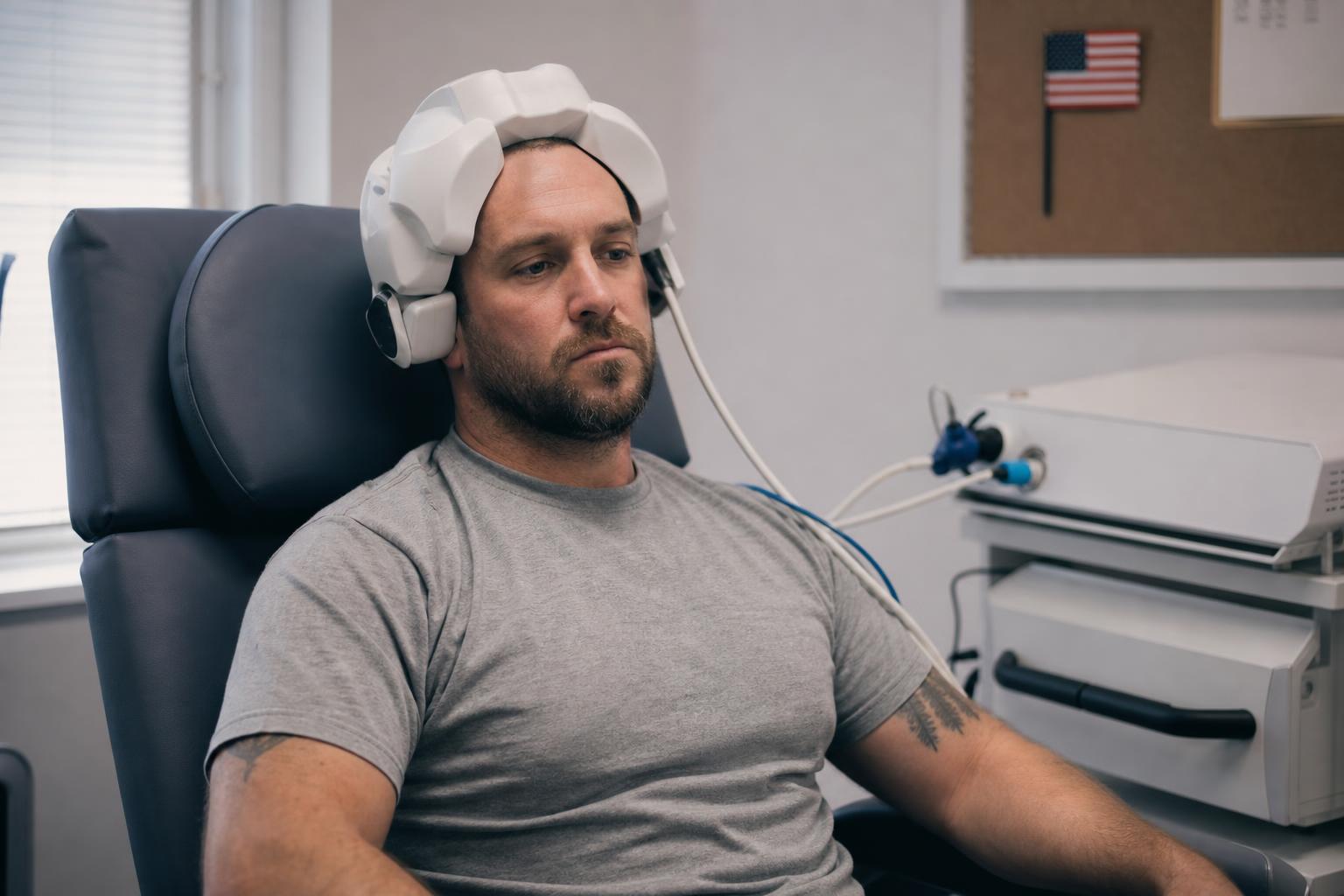
Across veteran communities online, a pattern keeps emerging: veterans are trying cutting-edge mental health treatments — Deep TMS (Transcranial Magnetic Stimulation), Hyperbaric Oxygen Therapy (HBOT), Stellate Ganglion Block (SGB) injections, and ketamine infusions — and walking away frustrated when they don't work. The conversations are honest and painful. "TMS was just a placebo for me." "Ketamine was nice for two hours, nothing after." "HBOT set the bar high, everything else paled in comparison." "I burned my scalp and felt nothing."
These veterans are rightly focused on finding relief. But there's a critical piece most of them — and most generic VA benefits articles — completely miss: when these treatments fail, or when you require repeated escalation to increasingly aggressive therapies, the VA is legally required to treat that as evidence of severity. Under the General Rating Formula for Mental Disorders at 38 CFR § 4.130, treatment history and treatment resistance directly inform your disability rating tier.
This article explains exactly how to use your treatment records — including failed TMS sessions, HBOT cycles, ketamine infusions, and SGB injections — to pursue a higher VA mental health rating. If you've gone through these treatments and are still struggling, you may be sitting on powerful, unused evidence.
The Legal Framework: How 38 CFR § 4.130 Actually Works
The VA rates all mental health conditions — PTSD (DC 9411), Major Depressive Disorder (DC 9434), Generalized Anxiety Disorder (DC 9400), and others — under a single General Rating Formula for Mental Disorders found at 38 CFR § 4.130. The key insight most veterans miss is this: the VA does not rate you on your diagnosis. It rates you on functional impairment.
The rating tiers break down as follows:
- 10%: Symptoms present but mild; do not significantly interfere with occupational or social functioning; controlled by continuous medication.
- 30%: Occasional decrease in work efficiency; intermittent periods of inability to perform tasks; some difficulty in establishing or maintaining effective relationships.
- 50%: Reduced reliability and productivity at work; flattened affect; frequent panic; impaired judgment; disturbances of motivation and mood; difficulty in understanding complex commands.
- 70%: Deficiencies in most areas including work, school, family relations, judgment, thinking, and mood. Suicidal ideation, near-continuous panic, and chronic sleep impairment all qualify here.
- 100%: Total occupational and social impairment — gross impairment in thought processes, persistent danger to self or others, intermittent inability to perform activities of daily living.
Here is the critical legal point: the VA is required under 38 CFR § 4.7 to assign the higher rating when your symptoms fall between two rating levels. Treatment failure and treatment escalation are direct, documented proof that your condition is not being controlled — which moves the needle toward a higher tier.
Why Treatment Failure Is Evidence of Severity — Not Just Bad Luck
When a veteran tries a standard antidepressant and it works, the VA may interpret that as symptom control, potentially capping a rating at 10% or 30%. But when a veteran has progressed through first-line medications, then standard TMS, then Deep TMS (BrainsWay's H-coil system, which penetrates deeper into the brain than conventional TMS), then HBOT, then ketamine infusions — and still cannot function normally at work or in relationships — that clinical trajectory tells a story the VA cannot ignore.
Every failed treatment in your VA or private medical records is documented evidence of a condition that resists control. Under the rating formula, a mental health condition requiring "continuous medication" is the floor — 10%. A condition requiring escalating, experimental, or multi-modal intervention that still fails to restore normal functioning maps directly onto the 50%, 70%, or even 100% criteria.
Consider what the record looks like when a veteran has completed, for example, 22 sessions of standard TMS with no relief, then attempted HBOT for TBI-related cognitive and mood symptoms, then received SGB injections targeting the amygdala's fear response — all with minimal lasting benefit. That is not a 10% veteran. That is a veteran whose condition, objectively documented by treating clinicians, has resisted every available intervention. The VA adjudicator reading that file must rate the functional impairment, not the diagnosis on the cover page.
How to Document Treatment Failure for Maximum Claims Impact
Documentation is everything. The VA adjudicator and the C&P examiner who evaluates your claim will rely heavily on what your medical records actually say — and on what your own statements describe in functional terms. Here is how to build the strongest possible record:
Step 1: Obtain Every Treatment Record
Request your complete VA treatment records through MyHealtheVet or a formal records request. If you received HBOT, ketamine, SGB injections, or Deep TMS outside the VA system, request those records directly from each private provider. Under 38 CFR § 3.159(c)(1), the VA is required to assist you in obtaining federal records, but private records are your responsibility to submit. Do not assume the VA will gather them.
Step 2: Get a Provider Statement That Uses Functional Language
A treatment note that says "patient completed 36 TMS sessions" is far weaker than one that says "patient completed 36 Deep TMS sessions with inadequate response; continues to demonstrate significant impairment in occupational functioning, social isolation, and persistent anhedonia." Ask your treating psychiatrist, psychologist, or neurologist to document why treatment was escalated, what the response was, and how your current symptoms continue to impair your daily functioning.
If your provider will write an independent medical opinion (IMO) or a letter addressing your functional status, even better. The letter should explicitly reference how your remaining symptoms — after exhausting these treatment modalities — affect your ability to maintain employment, relationships, and activities of daily living. This language maps directly onto the 38 CFR § 4.130 rating criteria.
Step 3: Submit a Personal Statement (VA Form 21-4142)
Under 38 CFR § 3.303, lay statements from veterans carry evidentiary weight. Your personal statement should describe — in plain, specific language — what your life looks like after treatment. Not what your diagnosis is. Not what treatment you tried. What your day actually looks like.
Examples of functional language that maps to rating criteria:
- "I missed work three times last month due to inability to get out of bed." (Occupational impairment → 50–70%)
- "I have not attended a family gathering in over a year due to hypervigilance and panic in crowds." (Social impairment → 50–70%)
- "I have experienced passive suicidal ideation on at least four occasions in the past six months." (Suicidal ideation → 70%)
- "I cannot maintain a consistent sleep schedule despite medications and HBOT; I average fewer than four hours of sleep most nights." (Chronic sleep impairment → 70%)
Step 4: File a Claim for Increased Rating Using VA Form 21-526EZ
If you are already service-connected for a mental health condition and your symptoms have worsened — or were never rated at the correct level — file a Claim for Increase using VA Form 21-526EZ. You can file this at any time. There is no limit to how many times you can file for an increase when genuine worsening or new evidence exists.
Attach your treatment records, provider statements, and personal statement. Request a new Compensation and Pension (C&P) exam. At that exam, describe your functional impairment specifically — not just your symptoms in the abstract. Mention every treatment you have tried, the duration, the lack of lasting response, and how your current symptoms affect your work, relationships, and daily life.
A Note on Provider Misconduct and Patient Rights
The Reddit thread also surfaces a disturbing but not uncommon experience: veterans being pressured or coerced by mental health providers into treatments they do not consent to, or having providers prescribe medications incompatible with DOD requirements without disclosing that conflict. This is a serious issue that goes beyond claims strategy.
If you experienced a provider who pressured you, yelled at you, or withheld information about treatment options, you have the right to file a complaint through the VA's Patient Advocate office at your facility, or formally through the VA Office of Inspector General. You also have the right to request a different provider under the Veterans Access to Care provisions. A coercive clinical encounter should be documented in writing immediately, as it may be relevant both to your treatment record and to any future claims.
Deep TMS vs. Standard TMS: Why the Distinction Matters for Your Claim
Not all TMS is the same, and your claims file should reflect that. Standard TMS uses surface-level magnetic pulses targeting the dorsolateral prefrontal cortex. Deep TMS (BrainsWay H-coil system) uses a different coil geometry to reach structures up to 4–6 cm beneath the skull, including areas implicated in OCD, PTSD, and treatment-resistant depression. Deep TMS is FDA-cleared for Major Depressive Disorder, Anxious Depression, OCD, and Smoking Addiction.
If your records show you failed standard TMS and were then escalated to Deep TMS, that escalation itself is evidence of severity. If you then failed Deep TMS and moved to ketamine or HBOT, that trajectory is a documented ladder of treatment resistance. Make sure your C&P examiner understands the distinction. Many general practitioners and even some VA examiners conflate the two, which can undervalue the significance of your treatment history.
The Bottom Line: Your Struggle Is Evidence
Veterans who have tried Deep TMS, HBOT, SGB injections, and ketamine and found little lasting relief are not failures. Their treatment trajectories are objective, clinician-documented proof that their mental health condition is severe, persistent, and resistant to control — exactly the profile the General Rating Formula at 38 CFR § 4.130 is designed to capture at the 70% or 100% tier.
Do not let an outdated or underestimated rating stand. Gather your treatment records. Get a functional statement from your provider. File for the rating you have actually earned through years of fighting a condition that refused to yield — even to some of the most advanced interventions medicine has to offer.
If you need help building your claim file or identifying the right VSO or accredited claims agent, start at VA.gov/decision-reviews or contact your nearest Veterans Service Organization. You served. The evidence is already there. Now use it.